Get alerts for ballots, on-sales, resale windows and price drops
before the best tickets disappear.
Never Miss a London Ticket Drop
See Upcoming Events ↓
League Two is the lowest of the three EFL divisions and the boundary between the professional leagues and the National League below. Twenty-four clubs play 46 matches across a season running from August to May. Despite sitting at the fourth tier, it is fully professional, and many of its clubs have long histories and, in some cases, top-flight pasts.
It is also the division where the gap between football and finance is narrowest. Budgets are small, squads are thin, and a cup run or a play-off place can materially change a club’s year. That gives the football at this level an urgency that is easy to underestimate from the outside.
League Two promotes more clubs than the divisions above it. The top three are promoted automatically to League One. The clubs finishing fourth to seventh contest the play-offs, with two-legged semi-finals and a final at Wembley deciding a fourth promotion place. Only the bottom two clubs are relegated, to the National League.
That asymmetry — three up automatically, only two down — is deliberate. Dropping out of the EFL into the National League can be financially severe, and in some cases terminal, so the league structure limits the number of clubs exposed to that fall each season. It also explains the higher churn between League One and League Two, since League One relegates four clubs into a division that only sends two further down.
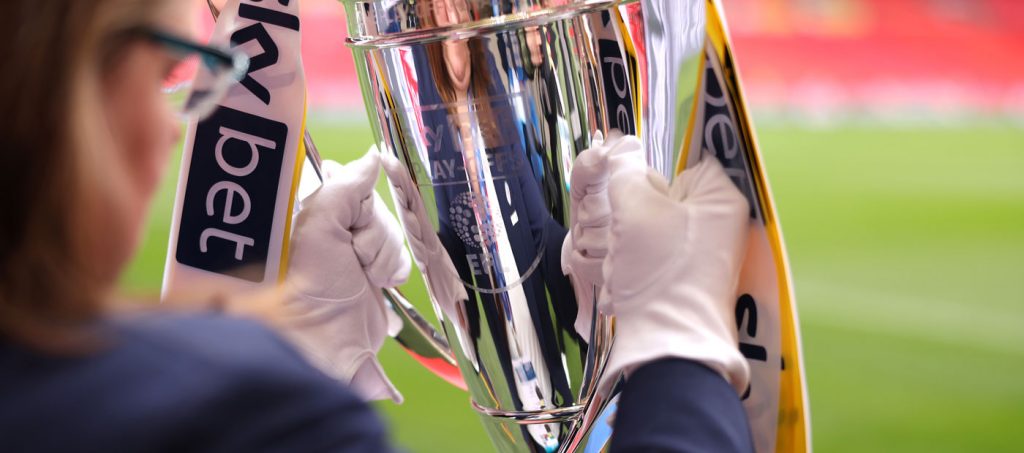
The League Two play-off final is the smallest of the three EFL finals in profile and often the largest in meaning. For clubs of this size a Wembley final can be the biggest match in their history, and followings frequently exceed a club’s entire average home attendance for the season.
Practically it is the same national-stadium experience as any other final: get there early, expect a stewarded exit, and spread across Wembley Stadium and Wembley Central stations rather than funnelling into Wembley Park. See the Wembley seating guide and Wembley transport guide for detail.
At the fourth tier, cup football is a financial event as much as a sporting one. League Two clubs contest the EFL Trophy, which is restricted to the 48 clubs of League One and League Two plus 16 invited Category One academy sides from Premier League and Championship clubs. It runs from 16 regionalised groups of four, divided north and south, with the academy teams playing all of their group fixtures away and two clubs from each group advancing to the knockouts. The final is played at Wembley, and for a club at this level it is the most winnable route to a national final that exists.
The FA Cup matters in a different way. League Two clubs enter at the first round proper, several rounds before the Premier League joins at the third round. A cup run that produces a home tie against a top-flight club can be worth more to a fourth-tier budget than a strong league season, which is why the abolition of replays from 2024–25 was felt most acutely at this end of the pyramid — a replay at a big ground was one of the most reliable windfalls in the lower leagues.
Clubs that regularly feature at this level include Barnet, Bromley, AFC Wimbledon and Leyton Orient. Division membership changes every season through promotion and relegation, so treat any list of clubs as a snapshot rather than a fixed roster — always check the current table before booking travel.
League Two is where London’s smaller professional clubs are most visible, and several of them have arrived here from the National League in recent years. For supporters it offers the cheapest and most accessible professional football in the city — see where to watch football in London for how it fits alongside the rest of the capital’s options.
The grounds are small, and that is the appeal. The Hive Stadium in Edgware is a modern, compact ground in north-west London; Hayes Lane in Bromley is a traditional non-league-style ground that has moved up into the EFL with its club, and also hosts women’s football; Brisbane Road is Leyton Orient’s long-standing home in east London; and the Cherry Red Records Stadium is AFC Wimbledon’s ground in Plough Lane.
At this level you are close enough to the pitch to hear the players, queues are short, and it is normally possible to turn up on the day. Travel is straightforward by rail or Underground in every case, and matchday parking around these grounds is typically residential and restricted.
League Two is the most affordable professional football in London. Adult tickets commonly start from around £15–£22, with concessions substantially lower, and family pricing is common. Walk-up entry is realistic for most fixtures outside derbies and the festive period.
Boxing Day and New Year fixtures are the busiest of the year and are traditionally scheduled locally to limit travel. They sell out early and coincide with reduced public transport, so plan ahead using the Boxing Day football in London guide.