Last updated: August 11, 2026
Get alerts for ballots, on-sales, resale windows and price drops before
the best tickets disappear.
Free London ticket alerts
Never Miss a London Ticket Drop
The race was founded in 1981 by the former Olympic athletes Chris Brasher and John Disley, who came back from running the New York City Marathon convinced London could stage something similar. It grew into the biggest mass-participation event in Britain and one of the six Abbott World Marathon Majors, alongside Boston, New York, Chicago, Berlin and Tokyo.
Two things set it apart from the other Majors. The first is scale: the 2026 race finished 59,830 runners, a Guinness World Record for the most finishers of a marathon, and the field has grown year on year. The second is money. London is the world’ biggest annual one-day fundraising event, and the charity element is not a side note — for most of the field it is the reason they are running at all.
The elite races run at the front of the same event on the same closed roads, which is unusual in professional sport: the amateur field covers the identical course, on the same morning, a few hours behind world-record holders. That combination of elite competition and mass participation is what gives the day its character.
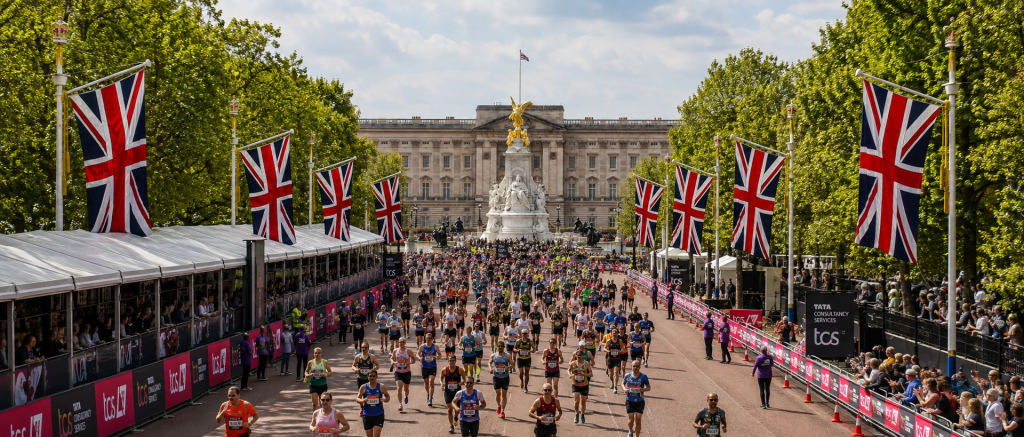
The course runs from Greenwich in south-east London to Westminster, starting on Blackheath and finishing on The Mall. It is flat, fast and almost entirely closed to traffic, which is why it attracts record attempts as well as first-timers.
The early miles pass through Greenwich and Deptford, with the Cutty Sark at around mile six the first of the landmark crowd points. Tower Bridge arrives near the halfway mark and is the most photographed section of the race. The course then heads east into the Isle of Dogs and Canary Wharf, before turning back west along The Highway and the Embankment for the closing miles past the Tower of London, Big Ben and Birdcage Walk to the finish.
For spectators the practical consequence is that the route doubles back on itself, so with a little planning it is possible to see runners twice from the same part of London. The London Marathon day guide covers the viewing points, which stretches get uncomfortably crowded, and the quieter alternatives.
The 2027 race is the biggest change in the event’ history. For one year only the marathon will be staged across two days, on Saturday 24 and Sunday 25 April 2027, with 100,000 participants split between them. Both days use the same Greenwich to Westminster route.
The elite programme splits across the two days as well. Elite women, female para-athletes and the championship and Good For Age women race on one day; the elite men, male para-athletes and the championship and Good For Age men race on the other. That gives each elite race its own day and its own broadcast window rather than sharing one.
The reason is demand the single-day event can no longer absorb. Organisers estimate the expanded format could raise more than £150 million for charity, with the additional income distributed by the London Marathon Foundation to projects encouraging activity among children and young people. The Double is explicitly a one-off, so 2027 is the only year the race is scheduled to run this way.
The public ballot is the main route in and the odds are long. For the 2027 race 1,338,544 people applied, up eighteen per cent on the previous year and a fourth consecutive world record for entries to a marathon ballot. The ballot typically opens in the days immediately after the race is run and closes within about a week, with results issued several months later.
Charity places are the most reliable alternative. Registered charities are allocated places and pass them to runners who commit to raising a minimum sum, which is usually a substantial four-figure target. That route is how a large share of the field gets in, and it is why the fundraising totals are what they are.
Beyond those, Good For Age places are available to runners who have hit a qualifying time for their age group at an eligible marathon, and Championship entry exists for club runners at a considerably quicker standard. Overseas tour operators hold allocations too. What does not exist is a general sale — there is no way to simply buy a place.
Watching is free and needs no ticket, which makes this one of the most accessible major sporting events in the country. Roughly three quarters of a million spectators line the course, and the atmosphere is closer to a street festival than a sporting crowd, particularly through Greenwich, Bermondsey and the closing miles.
The trade-off is that the famous spots are extremely busy. Tower Bridge and Canary Wharf fill early and the view from the back of a crowd several deep is limited. The quieter stretches in the east and the outer parts of the course offer far better viewing and are easier to reach on the day.
Road closures are extensive and last most of the day, so the Underground and rail are the only sensible way to move around. If you are supporting a specific runner, agree a meeting point in advance and expect mobile signal to be unreliable in the crowds.
The marathon is the anchor of the capital’ spring sporting calendar and the largest participation event London stages. It sits alongside the city’ wider sporting events programme, and for anyone following running and track more broadly the athletics page covers the competitive side of the sport in London.
Last updated: August 11, 2026